7 Strategies to Boost Your Brand’s AI Search Visibility
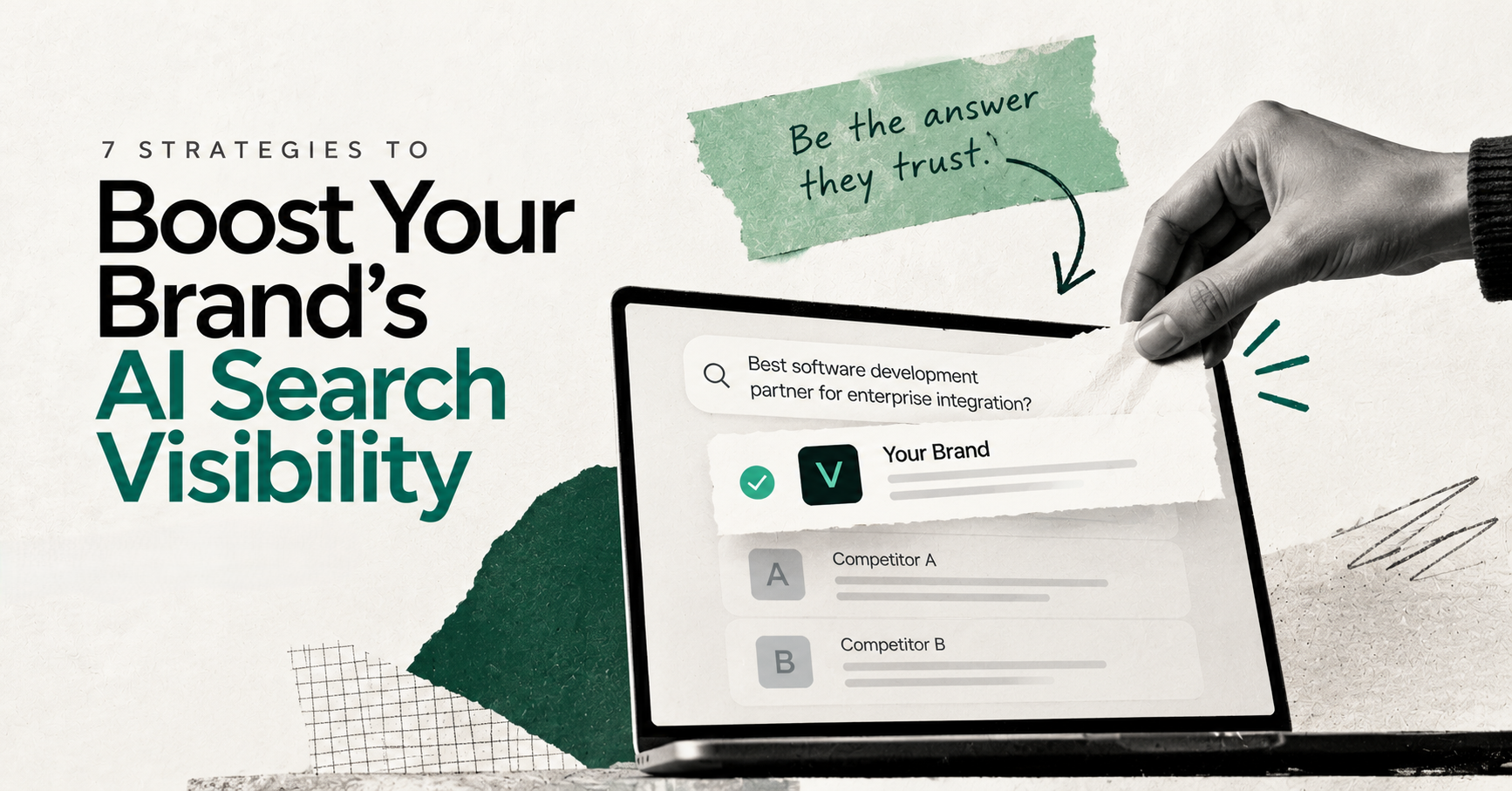
Picture this: someone opens ChatGPT or Perplexity looking for a software development partner for their next big rollout. Your company builds exactly what they need. You’ve put years into SEO, your pages rank well on Google, and your case studies speak for themselves.
Yet when the AI spits out three recommendations, your competitors get the nod—and your name isn’t even mentioned.
That’s the silent blind spot hitting businesses right now. Getting eyes on your brand isn’t just about winning a blue link on page one anymore. It’s about whether LLMs understand who you are, trust what you do, and feel confident enough to recommend you. That’s where Generative Engine Optimization (GEO) comes in.
What Is Generative Engine Optimization (GEO)?
At its core, GEO is about shaping how your brand shows up inside AI-generated answers—whether that’s ChatGPT, Perplexity, Gemini, or Google AI Overviews. We’re talking about direct mentions, sourced citations, and actual recommendations.
Think of it this way: traditional SEO focuses on getting search bots to crawl, index, and rank specific web pages. GEO builds right on top of that foundation. It makes sure AI models can synthesize your expertise, verify your credibility, and comfortably cite you as a trusted source.
One doesn’t kill off the other. You need both working together to cover how modern buyers actually search.
GEO Strategies to Improve AI Search Visibility
1. Cut the textbook fluff and write for the buyer’s dilemma
Publishing another "What is Cloud Modernization?" guide does nothing for you. LLMs already have a billion definitions for that.
What can make your content more useful as a citation is the messy, practical stuff. When our tech leads write, we focus on the trade-offs prospects argue over internally—like the hidden risks of wrapping an API around a 15-year-old monolith versus refactoring it from scratch. Give the direct verdict upfront, call out where things usually go wrong, and skip the preamble.
2. Win mentions outside your own domain
An LLM doesn’t take your site’s claims at face value. It looks for consensus across the web before it ever risks recommending your brand.
That means your name needs to show up where real industry vetting happens—in technical communities, verified client reviews on Clutch or G2, podcasts, and co-authored pieces with partners. You’re not chasing empty volume or spam backlinks here. You’re building a credible track record across independent platforms that AI systems may use to discover or verify information about your brand.
3. Format your insights so they are impossible to miss
If a key takeaway is buried inside an eight-line wall of text, both a busy CTO and an AI crawler will skim right past it.
Break up the flow with punchy headings, two-sentence paragraphs, and straightforward comparison tables. If you’re discussing architectures or software frameworks, outline the pros, cons, and exact use cases cleanly. When your layout is structured, AI systems can more easily identify the core insight, although clear formatting alone doesn't guarantee a citation.
4. Stop accidentally blocking AI crawlers
The best content in the world won’t help if an AI crawler hits a wall trying to read it.
We frequently audit client setups and find their robots.txt quietly blocking GPTBot, PerplexityBot, or ClaudeBot. Take the time to check your crawler permissions, tighten page speeds, and clean up broken redirects. Adding valid JSON-LD structured data for your organization and relevant services can help search engines interpret your information, but it doesn't guarantee that AI platforms will understand or cite your brand.
5. Keep your positioning consistent across every touchpoint
If your website says you’re an enterprise data consultancy, but your company profiles say "full-service digital shop" and old directories list mobile app fixes, you confuse the model’s entity graph.
Pick your primary lanes and stick to them everywhere your brand has a footprint. On your blog, weave related topics into tight clusters. If enterprise integrations are a core focus, link your articles on data pipelines, legacy APIs, and middleware so search models recognize the clear boundaries of your expertise.
6. Write for conversational prompts, not two-word keywords
Buyers don’t talk to ChatGPT the way they type into Google. They don’t search "custom CRM software." They prompt: "We’re outgrowing Salesforce on a 200-person team—what are the most stable alternatives that integrate with AWS?"
Build your content around those exact scenarios. Cover the edge cases, security concerns, budget friction, and migration roadblocks. When your copy speaks to real-world context, it naturally aligns with the conversational prompts people use every day.
7. Treat prompt audits like regular rank tracking
You can’t rely on Google Search Console to figure out how AI sees your business.
Set a calendar reminder twice a month to query ChatGPT, Perplexity, and Gemini using realistic buyer questions. Take note of who gets recommended, which links appear in the footnotes, and how your competitors are described. If you aren’t in the answer, look closely at what the cited sources covered that you didn’t, and update your content roadmap accordingly.
Where to Start With Your Own GEO
At the end of the day, GEO isn't about gaming an algorithm. It's just about giving AI models clear, dependable reasons to trust what you do.
The easiest first step is to test it yourself. Ask a couple of AI engines the exact questions your prospects ask before hiring someone, see what comes back, and look at the gaps in your content or crawler setup.
If you want an extra set of eyes on it, that’s where Vovance’s Generative Engine Optimization (GEO) service helps out. We run audits to see how models currently view your business, clean up mixed entity signals, and help you structure content that actually earns citations.
Drop your core buyer questions into a prompt box today. Seeing how AI describes your company right now makes it a lot easier to figure out what to fix first.