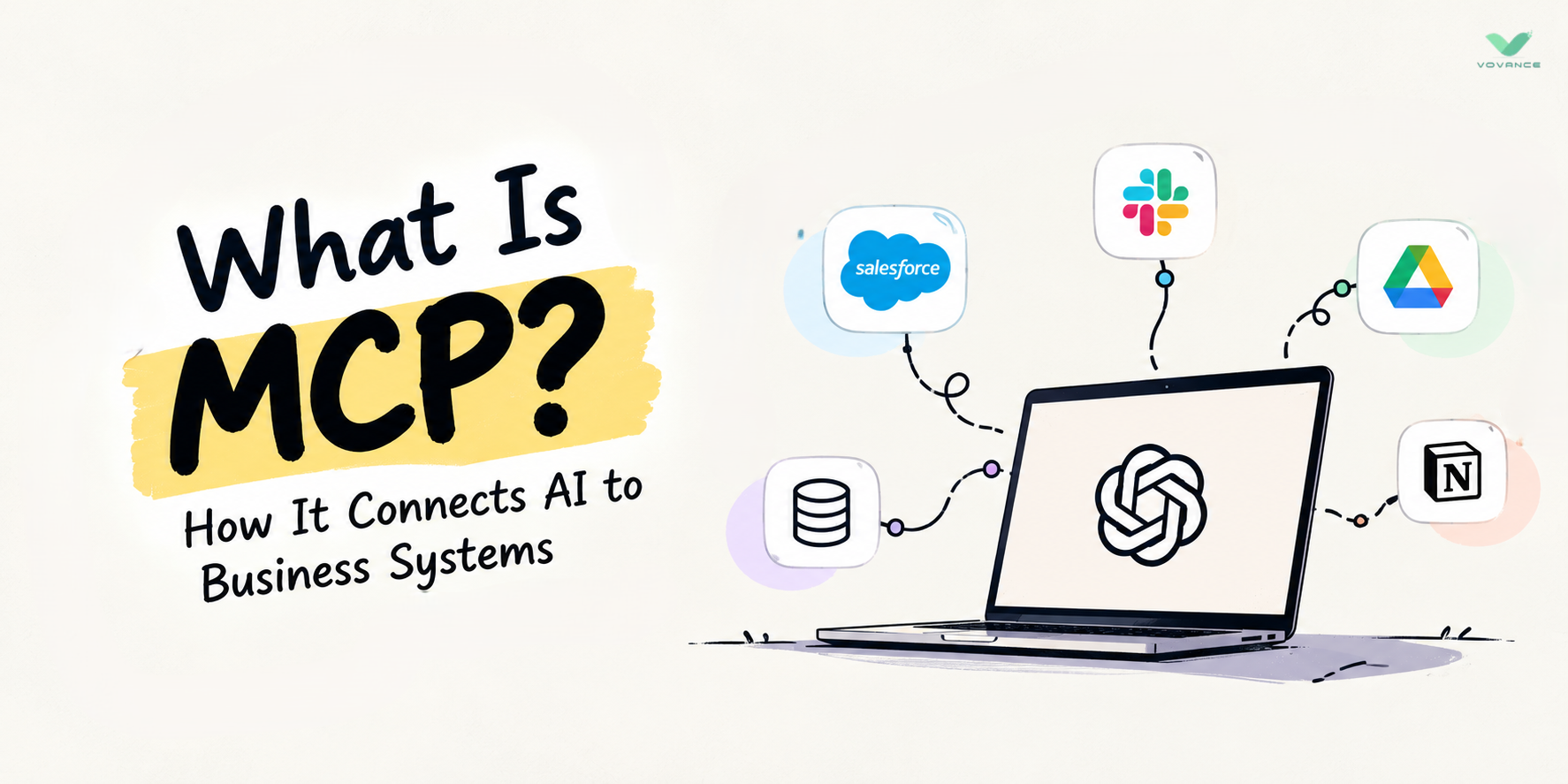
What Is MCP? How It Connects AI to Business Systems
AI can draft reports and summarize conversations, but it stalls when the answer lives inside a CRM, an internal database, or a project management platform. A model can’t use information it has no connection to.
The Model Context Protocol (MCP) is a common answer to that gap. It gives AI applications a standard way to connect to external tools and data sources, so teams don’t have to build a separate connection for every pairing of AI tool and business system. If you’re asking what MCP is, the short version is that it helps AI work inside the systems a business already runs on.
What is MCP (Model Context Protocol)?
MCP is an open protocol that standardizes how AI applications communicate with external data sources, tools, and services. Think of it as a shared plug standard: an AI application can work with many different systems without a custom integration for each one.
An assistant might need customer details from a CRM or progress updates from a task management platform. MCP gives those systems a structured way to expose their information and capabilities to the assistant.
It has limits. MCP doesn’t make a model aware of every system in your company. Someone still has to configure the connections, decide what information is available, and set which actions are permitted.
How does MCP connect AI to business systems?
MCP uses a client-server architecture with three main pieces. The host is the AI application where someone makes a request. The client inside it manages communication with MCP servers. Each MCP server exposes approved tools, resources, or capabilities from one connected system.
Say a sales team wants a summary of a customer’s latest interactions. The assistant calls an MCP server connected to the CRM, retrieves the customer information it’s permitted to see, and writes the summary from that context. Other workflows follow the same pattern once the connections and permissions exist. MCP standardizes the communication, but the underlying systems still need to be integrated.
What can businesses do with MCP?
MCP earns its place when AI needs information beyond the conversation itself. In sales and customer service, an assistant can retrieve customer history to help teams prepare responses and follow-ups. In operations, it can pull from several connected systems to summarize activity for reporting. In project management, it can collect task updates and compile progress across tools.
Each of these can cut down on employees switching between applications to gather information. The results still depend on data quality, how reliable the integrations are, and how well the workflow is designed.
What to consider before implementing MCP
Connecting AI to business systems brings new responsibilities, and four questions are worth settling early.
Start with access: limit an AI application to the information and actions it actually needs. Then look at security, including authentication, how far you trust each server, and how sensitive information is handled. Check integration readiness too, meaning whether your existing applications can expose the data and functions the connection requires. Finally, plan for monitoring. Track access and tool usage, and require human approval for sensitive actions where it makes sense.
MCP is a standardized communication layer and doesn’t secure anything by itself. How safe a connection is depends on the controls around it and how it’s managed.
How Vovance helps connect AI with business systems
Making AI useful in an enterprise takes more than choosing a model. The systems behind it have to communicate reliably, data has to stay accessible to the right people, and workflows have to fit how the business actually operates.
That is the focus of Vovance’s AI Solutions & Implementation: connecting technologies and implementing AI so it supports existing operations. If you’re considering MCP, get in touch with our team.