Why Your Brand Shows Up on Google but Not in AI Search
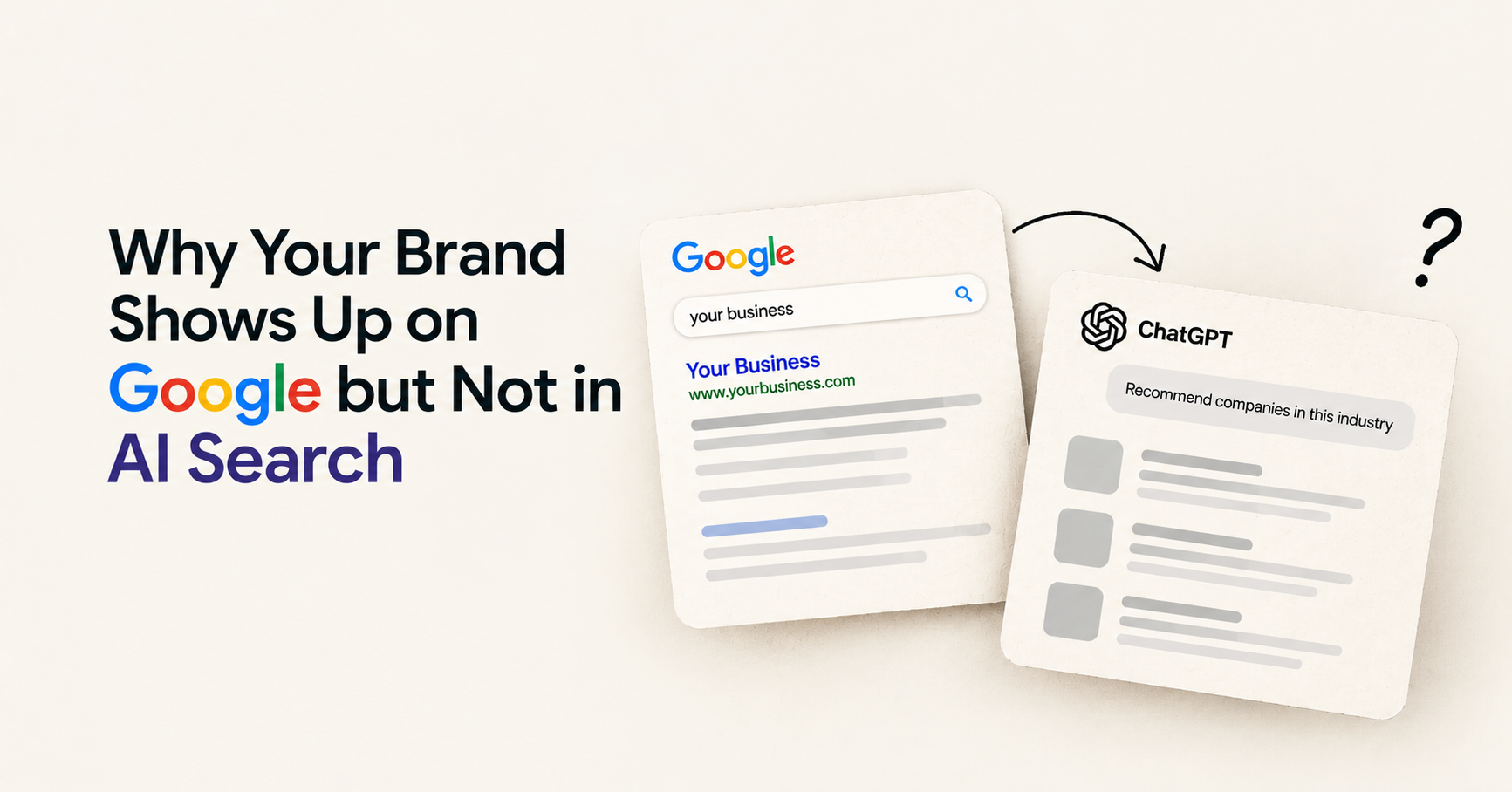
You search for your business on Google, and there it is. Your website ranks for relevant keywords, your blogs are getting published, and your SEO work is moving in the right direction. But ask ChatGPT to recommend companies in your industry, and you'll probably find a few competitors before you find yourself.
It's a strange gap to deal with. Your brand is online, so why isn't it showing up where people are looking for answers? The answer isn't always about rankings. Sometimes, it's about how your business is understood, what information is available about it, and whether AI search tools can find and use that information.
Why Google Rankings Don't Guarantee AI Search Visibility
A Google ranking gives people a way to find your page. An AI-generated answer works differently. Depending on the platform and the query, an AI tool might retrieve information from several sources, compare what's available, and use selected details to build its response.
Your page could rank well without ever being used in that answer. Perhaps it doesn't cover the question in enough detail. Maybe another source explains the topic more clearly, or your brand simply isn't well represented across the sources the tool uses.
There's no single reason this happens, and each AI platform can behave differently. That's why improving rankings alone may not solve the problem. Businesses also need to look at how clearly their expertise comes across online and whether useful, reliable information about them is available.
4 Reasons Your Brand Is Missing From AI Search
1. Your website says a lot without saying much
Phrases like "end-to-end technology solutions" sound familiar on business websites, but they don't tell a potential customer much. What does your company actually build? Which problems can it solve? Who is it best suited to work with?
If visitors have to dig through several pages to figure that out, your positioning probably needs work. Start with your service pages. Explain what you offer, where it fits, and what a customer can expect. Specific information is more useful than another paragraph of broad promises.
2. Your content covers topics but misses the real question
Publishing regularly doesn't automatically make a website useful. A blog can target the right keyword and still leave readers looking for answers.
Think about someone comparing custom software with an off-the-shelf product. They need to understand the trade-offs, costs, limitations, and situations where each option makes sense. A generic introduction to software development won't get them very far.
Good content goes beyond defining a topic. It helps someone understand it, make a comparison, or decide what to do next. That's the kind of depth worth building into your content strategy.
3. Your brand exists online, but the picture is incomplete
Your website is one source of information about your business. Reviews, industry articles, business directories, and relevant third-party mentions can add other perspectives.
When those sources contain useful, consistent information, they can help establish a clearer picture of your brand. If your company has little presence beyond its own website, that picture may be harder to establish.
This doesn't mean chasing backlinks or getting your name mentioned on every available platform. Focus on relevant sources and genuine contributions that make sense for your industry.
4. Search systems may struggle to access your content
Sometimes, the issue is technical. Important pages might be blocked from crawling, excluded from search indexes, or difficult to render correctly.
Check your indexing settings, robots.txt rules, internal links, and page structure before assuming the content itself is the problem. Structured data can also clarify details about your organization and services, though it won't guarantee that an AI tool will cite you.
One important distinction: access varies across platforms. A page being available to Google doesn't automatically mean every AI search tool can retrieve and use it in the same way.
GEO Best Practices to Improve Your Brand's AI Search Visibility
GEO optimization starts with the information your business already has online. Before building an entirely new content strategy, look at what's unclear, missing, or difficult to find.
Give people a clear picture of your business
Your homepage and service pages should make it easy to understand what you do, who you help, and which problems you solve. Keep those details consistent across your website and relevant business profiles. Don't make readers piece together your expertise from scattered pages.
Make your content worth referencing
This is where quality matters more than volume. Answer the question properly, explain the reasoning behind your recommendations, and include examples or evidence where you can support them. If two approaches have different trade-offs, explain both instead of forcing a one-size-fits-all answer.
You don't need to turn every blog into a technical guide. You do need to give readers something more useful than a surface-level explanation they could find anywhere.
Sort out the technical details
Review whether important pages can be crawled and indexed, whether internal links lead to relevant content, and whether your pages communicate information clearly. Use structured data where it accurately describes the content.
These steps won't guarantee AI visibility, but they help remove avoidable problems that could affect content discovery.
Build credibility where your audience looks
Useful contributions to industry publications, honest customer reviews, and relevant mentions can strengthen your brand's wider online presence. Focus on earning that attention through real expertise rather than treating every mention as an SEO tactic.
How to Measure Your GEO Performance
Start with a small set of questions your customers might actually ask. Try them in ChatGPT, Gemini, and Perplexity, then note whether your brand appears, how it's described, and which competitors or sources are mentioned.
Repeat the checks over time. AI responses can change between queries, so one answer isn't enough to tell you whether your visibility has improved. The patterns are more useful than any single result.
SEO and GEO Should Work Together
Your Google rankings are still valuable, but they don't tell the whole story of how customers discover your business. Generative engine optimization (GEO) extends the work by focusing on clear brand information, useful content, technical accessibility, and credible external signals.
That's where Vovance can help. Through its GEO services, Vovance helps businesses improve their AI search visibility by working on the content, technical SEO, and website gaps that may be holding them back. The first step is understanding what's missing and figuring out what needs to change.